Phillips Mushroom Farms enjoys a long legacy of success
Phillips Mushroom Farms enjoys a long legacy of success
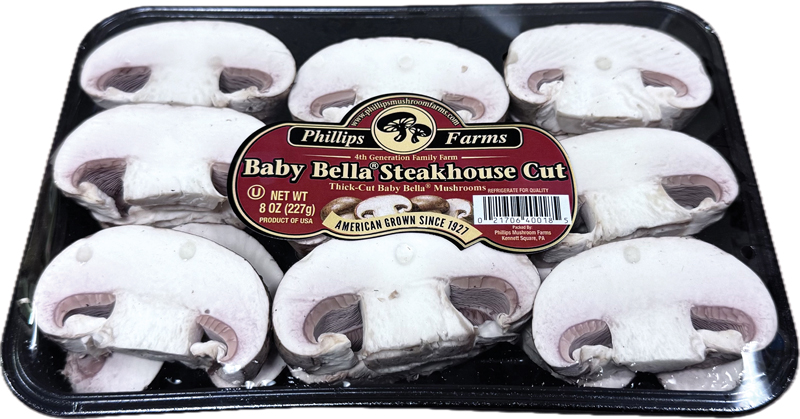
Phillips Mushroom Farms traces its roots back to 1927 when the Phillips family began cultivating mushrooms in Kennett Square, PA. Today, the company continues to operate from that same property, shipping fresh mushrooms to customers nationwide.
This year, the company has seen continued demand for convenience, value, and versatility.
“At retail, sliced mushrooms, larger pack sizes, organic options and specialty blends continue to resonate,” said Sean Steller, director of business development at the Kennett Square, PA-based company. “In foodservice, mushrooms are benefiting from menu trends around plant-forward eating, umami flavor, clean ingredients and cost-effective menu options. Mushrooms remain one of the few ingredients that work equally well as a center-of-plate item, a blend-in ingredient or a premium topping.”
While white and Baby Bella mushrooms still drive the majority of volume, specialty varieties continue to gain attention, especially Shiitake, Oyster, Lion’s Mane, Maitake, Royal Trumpet, Chestnut and Pioppini.
“Phillips differentiates through scale, consistency, variety and heritage,” Steller said. “We offer a full line of conventional, organic, specialty, sliced, whole and value-added mushroom products, backed by nearly a century of growing experience. Our advantage is being able to combine large-scale supply reliability with specialty mushroom expertise and new product innovation.”
Sustainability is central to mushroom farming and a big part of Phillips’ philosophy.
“Mushrooms are efficient to grow, require relatively little land and fit naturally into circular agricultural systems,” Steller said. “For Phillips, sustainability also means responsible growing practices, efficient resource use, waste reduction and helping customers tell a stronger sustainability story through mushrooms as a plant-forward, low-impact food.”
During summer, the company supports retailers with merchandising ideas that connect mushrooms to grilling, burgers, kabobs, salads and easy weeknight meals.
“Portabellas, sliced mushrooms, stuffed mushrooms and specialty blends all work well for summer displays,” Steller said.
The Phillips family has been growing mushrooms since 1927, and that history gives the family a deep knowledge of the crop, the market and customer expectations.
“Our scale allows us to provide consistent supply, while our experience helps maintain quality across a broad assortment,” Steller said. “We combine traditional growing knowledge with modern food-safety, quality systems and customer service. Our history of innovation fuels forward momentum even in challenging times for the mushroom industry.”
This year has presented some challenges for the company, but its long history has prepared them for when issues come along.
“Like many produce businesses, we’re managing labor pressure, energy costs, packaging costs, transportation and the need for reliable cold-chain distribution,” Steller said. “We’re addressing these challenges through operational discipline, investments in efficiency, strong customer planning, packaging optimization and maintaining a diversified product mix across retail, foodservice and value-added channels.”
Looking ahead, Phillips Mushroom Farms is optimized for growth in the core areas of consumer focus right now.
“Our state-of-the-art growing facilities are designed to prioritize quality, consistency and reliability,” Steller said. “In 2026, we will be expanding our specialty growing operation to handle the increased demand for these items. There are a handful of really exciting new products in the pipeline, including recently launched mushrooms like chestnut, new value-add items and more. The mushroom category has grown over the last century by way of continued innovation, and we don’t see that trend slowing down in 2026.”