Mr. Lucky covers diverse sectors
Mr. Lucky covers diverse sectors
irapuato, guanajuato, mexico — Mr. Lucky encompasses 10,000 acres of vegetable and berry production, packing 230 SKUs.
Whatever his responsibility, Miguel Usabiaga, the president of this produce giant is undaunted. Humble and sincere, Usabiaga is very calm in discussing his diverse firm.
Mr. Lucky ships 12 months a year, with the greatest volume in the winter and spring. Because of high domestic production levels in its key market, the United States, Mr. Lucky lowers its production from July to mid-October.
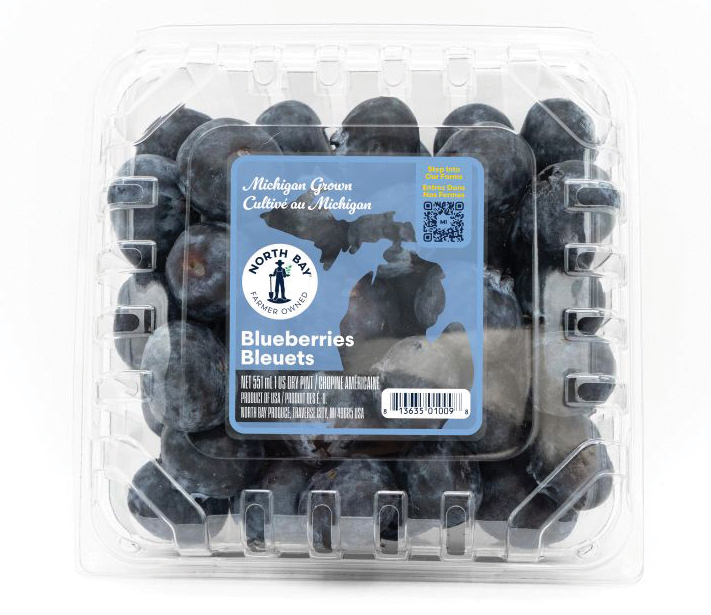
Beyond its vast and diverse fresh and pre-cut vegetable crops, Mr. Lucky has been producing strawberries for 15 years. The firm grows strawberries, blackberries and blueberries in Irapuato and the nearby state of Michoacán. The firm produces 57 acres of organic hothouse berries and 17 acres of conventional, open field berries. An additional 17 acres of new hothouses for berry production will be completed this spring, Usabiaga said.
Hothouses in Michoacán reduce energy costs by tapping water from 600 feet below the surface that is 130 degrees F.
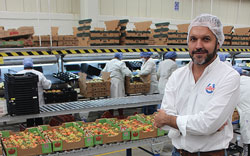 Miguel Usabiaga, the president of Mr. Lucky,in front of the firm’s Irapuato tomato packingline. Mr. Lucky exports to 15 countries, including the U.S., Canada, Australia, Puerto Rico, nations in Asia, Central America and South America, as well as South Africa, Italy, Russia and other European countries.
“We spread our markets to minimize our risk,” he noted.
Risks are also minimized by anticipating and adjusting for change. Fifteen years ago Mr. Lucky initiated internal food safety standards and set its own documentation and traceability program to preempt what many companies are facing today in serving countries around the world.
Mr. Lucky grows and packs its own brand, and private-labels for many U.S.-based produce companies.
Usabiaga credits the Guanajuato Department of Agriculture for establishing, effective in 2018, its own GAP food-safety standards that will earn a Guanajuato Premium Seal. This move was driven largely by his father, Javier Usabiaga, who recently retired as the Guanajuato Secretary of Agriculture.
Comparing Guanajuato to other Mexican states, Miguel Usabiaga indicated that “we have very good people here. We have skilled workers. The level of education is a little higher here than when you bring people from southern Mexico. They are easier to train.”
Mr. Lucky has a “ladder” incentive for its workers. This opportunity for promotion proves a huge boost to internal morale. The firm has a manager of almost 2,000 acres who started working at Mr. Lucky as a harvester. Many other employees have enjoyed less dramatic steps up. But the steps — and potential for steps — is motivating workers to make the most of their careers.
Those who have worked for the company for more than five years have the opportunity to receive academic scholarships.
Mr. Lucky provides nursery care and schools for workers. Children who achieve a 95 percent average on their school work receive a special recognition party. And their parents receive a financial bonus. When this program started about eight years ago, 24 children qualified for the recognition. This year 225 hit the goal.
“We also do a lot of community work. We go to where the workers are from and go and fix what needs to be fixed.”
Mr. Lucky’s personnel turnover is less than three percent from year to year, he noted.
While Mr. Lucky’s social responsibility programs have long been in place, the firm in December 2016 received its Fairtrade certification. “I think Fairtrade is good for the industry. We are high believers that [good business] ethics [for workers] play a huge role.”
Other positives in Guanajuato are “very smooth roadways” and relatively easy access to McAllen or Laredo, which are about 12-14 hours away.
“We have technology and communications. Everything you need” is in Guanajuato.